




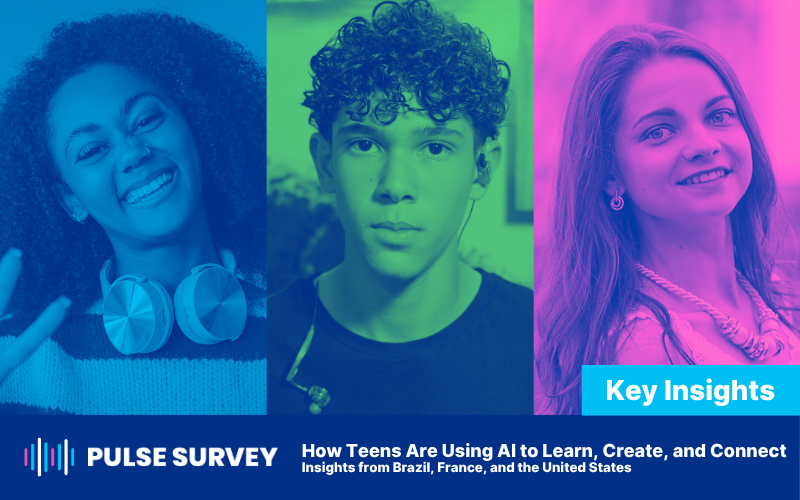
In our latest Pulse Survey, we sought to understand how nearly 2,850 adolescents across the United States, Brazil, and France are using AI chatbots for schoolwork, creativity, advice, and social connection, and how those patterns differ by country, gender, and frequency of use.
Brazil Leads in AI Adoption
How often teens use AI, and how important it feels in their lives, looks very different depending on where they live
46%
of Brazilian and 36% of American teens use chatbots daily.
20%
of French teens use chatbots daily, the lowest of the three countries.
70%
of Brazilian teens say AI chatbots are moderately or very important in their daily lives, compared to 38% of American, and 30% of French, teens.
Brazilian teens are also the most optimistic about AI’s impact on young people with 68% saying AI has a positive impact on young people, compared to 43% of American, and 39% of French, teens. In addition, American teens express the most concern about AI’s broader societal impacts, particularly around deepfakes, job displacement, and data privacy.
Learning Is the Dominant Use
Across all three countries, the most common use of AI chatbots is learning. At least two-thirds of teens frequently use AI to search for answers, research topics, or simplify complex material. Most teens also say AI is helping them engage with content more deeply and improve their skills.
84%
of Brazilian, 68% of French, and 61% of American teens agree that AI helps them understand content at a deeper level.
83%
of Brazilian, 64% of French, and 62% of American teens agree that AI helps them improve skills in areas they find difficult or challenging.
At the same time, a substantial share of teens use AI to bypass learning altogether. Around one-third of American teens and nearly half of Brazilian teens said they frequently use AI to complete entire school assignments, most often because they don’t know how to do the work themselves. This points to an opportunity for AI tools to be designed in ways that steer young people toward supported learning, rather than simply generating finished work.
The data also point to a call for AI-focused media literacy education. French teens were least likely to report receiving instruction around AI (e.g., using AI effectively, identifying/verifying AI-generated content) and were also least likely to frequently fact-check AI-generated information against other sources. In all three countries, the least common type of AI literacy education was around understanding bias.
AI Can Be Helpful for Creative Activities, But Not Always Fulfilling
Teens are using AI for a range of creative activities, including creative writing, digital art, and graphic design. But they differ on whether AI feels like it’s enhancing or diminishing their own creativity.
84%
of Brazilian, 55% of US, and 45% of French teens have used AI for digital art; 70% of Brazilian, 53% of US, and 37% of French teens for creative writing; and 69% of Brazilian, 54% of US, and 41% of French teens have used AI for graphic design
74%
of Brazilian teens agree AI helps them realize their creative vision, compared to 47% of American teens and 48% of French teens.
45%
of American teens say they feel less creative when using AI, compared to 33% of Brazilian and 37% of French teens.
At least three-quarters of teens across all three countries described using AI for creative work as fast, and about the same share described it as helpful. Most also said the final output felt authentic, original, and personal. But the gap between “AI is useful” and “AI helps me realize my creative vision” suggests the technology is being folded into creative practice in ways that don’t always feel generative for young people.
A Meaningful Share of Teens Turn to AI for Advice and Social-Emotional Purposes
Roughly one-third of teens in the US and Brazil frequently ask AI chatbots for advice on topics like college planning, health, and lifestyle, and a similar share frequently use chatbots to roleplay, express their thoughts and feelings, or socialize for companionship. Only 10–15% of French teens said the same.
Most teens aren’t turning to AI instead of people: at least half also sought advice from parents, friends, or other adults on the same topics. And among those who acted on AI advice, around 80% of US and Brazilian teens said it improved their situation, compared to 58% of French teens.
In the US, Gender May Shape How Teens Engage With AI
Gender differences were most pronounced among American teens, where boys reported using AI more frequently, more broadly, and in more socially-oriented ways than girls.
48%
of US boys say AI is moderately or very important in their daily lives, compared to 28% of girls.
42%
of US boys use chatbots daily, compared to 30% of girls. Boys also used AI more often for research (65% vs. 57%), discovering new topics (49% vs. 35%), and creating content (45% vs. 28%).
40%
of US boys frequently used AI to roleplay social scenarios, compared to 23% of girls.
Boys were also more likely to say chatbots can serve as a friend (46% vs. 33%) and help build social skills (43% vs. 32%). These patterns raise important questions about equity and risk, and about whether AI may be impacting the social development of boys and girls in different ways.
Daily Users Engage With AI In Notably Different Ways
The starkest differences in the study showed up between daily users and less frequent users. This pattern held across all three countries.
About half of daily US users—twice as many as less frequent users—said they thought of their chatbot as a real person (46%), had developed a close relationship with it (49%), or had real emotional conversations with it (51%). Among less frequent US users, those figures were less than half as high. Similar gaps appeared in Brazil and, to a smaller degree, in France.
Daily users were also far more likely to say chatting with AI is easier than talking to a real person, that it helps them feel less lonely, and that they feel the need to consult a chatbot before making decisions.
These patterns raise important questions about both the potential benefits and the risks of AI use, and point to the need for further research on what constitutes safe and healthy engagement for the heaviest adolescent users.
Platform Design, Education, and Context Shape AI’s Role in Teen Lives
AI chatbots are already embedded in many teens’ daily lives as tools, tutors, creative collaborators, and, for some, as companions. How they’re engaging depends heavily on where they live, their gender, and frequency of use.
For parents, educators, platform designers, and policymakers, the question isn’t whether AI is categorically helpful or harmful for young people. It’s whether the design choices, educational supports, and cultural contexts around AI will help this technology deepen learning and creativity.
A few questions to ask ourselves:
How should we be supporting adolescents—particularly boys and daily users—who are using AI in more personal, social, and emotional ways?
How can platforms design AI tools that encourage and support learning?
What would effective, developmentally appropriate AI literacy education look like across different cultural contexts?
Read the Full Report →This Pulse Survey was conducted by the Digital Wellness Lab at Boston Children’s Hospital, surveying nearly 2,850 teens aged 13–17 in late 2025. Full methodology is available in the report.