





Introduction
Research frequently seeks to understand how technology use can impact the physical, social, and emotional wellbeing of young people. But what about the ways which technology impacts how developing brains function and grow? There are additional factors which can make it difficult to determine if technology is directly impacting young people’s brains. While research is constantly evolving and new methodologies are helping researchers understand brain development and technology, there is much debate on the topic of technology and brain “rewiring”. To understand how technology interacts with brain development and functioning, we must zoom in on two critical periods of development – early childhood and adolescence.
This research brief contains two parts, each focused on one of the key developmental periods. It will explore the findings, methodologies, limitations of this research in its current state, and opportunities for future research. Due to the rapidly changing landscape of digital spaces, this research brief will primarily discuss findings from the past ten years.
The Early Years: Birth through Age 5
Cognition
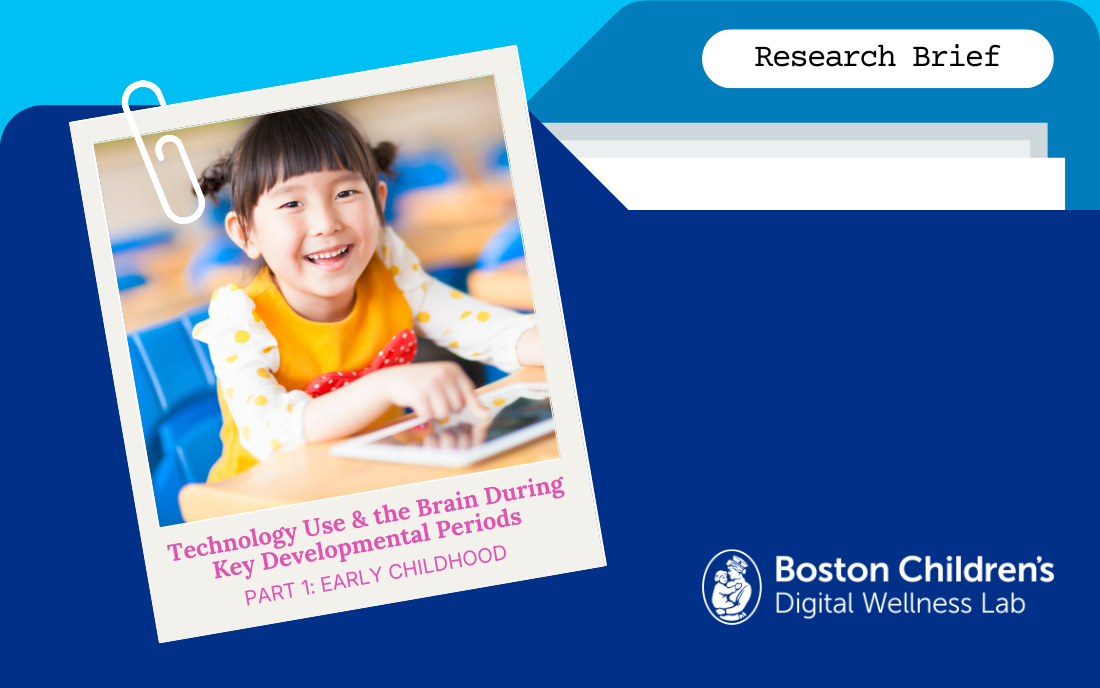
From birth through preschool, a child’s brain rapidly develops the cognitive abilities required for learning, executive function, and socialization. While much research has explored how screen use might interact with cognitive development, this research brief will focus on two critical factors for which there is a strong research base, emotional regulation and attention.
Emotional Regulation
The ability to bring technology everywhere has rapidly increased the accessibility of personal devices for even the youngest children. Common Sense reported in 2025 that by age 2, 40% of children in the U.S. had their own tablet, growing to over half (58%) by the time children are 4 years old (Mann et al., 2025). This growth in mobile device ownership means that children have greater access, and parents report that they often use technology to manage the demands of everyday life (e.g. Shin et al., 2021). This might include using devices to soothe a child who is dysregulated, or during times where a child’s behaviors may be distracting to others (e.g. while dining out, at a large gathering). However, evidence is building that using screens as a way to manage emotions may harm children’s ability to learn emotional regulation skills over time.
Using media as a way to regulate emotions is associated with more problematic screen behaviors (e.g. Christensen-Duerden et al., 2026; Coyne et al., 2021), and that from ages 3 to 5 those children who had higher levels of mobile device use to calm them had higher levels of emotional reactivity (Radesky et al., 2022). Children who are frequently given devices to regulate emotions also may react more negatively when those devices are taken away (Coyne et al., 2021). However, this poses a difficult challenge for parents, who may be more likely to use media to calm children who may already display challenging behaviors or emotional dysregulation. suggesting that this is a bidirectional relationship. Giving a child a device to soothe them may relieve parenting stress or anxiety in the moment, but likely results in more problematic behaviors in the future, for instance, greater reliance on media as a way to soothe, and continued emotional dysregulation over time (e.g. Coyne et al., 2021; Christensen-Duerden et al., 2026; Munzer et al., 2026; Radesky et al., 2022; Reich et al., 2026).
Attention
Throughout early childhood, children rapidly learn about the world around them and gain awareness of different stimuli in their environment. As screen media can be very engaging, there is a great interest in research exploring how screen time and content might affect children’s attentional development. Reviews of research finds that high screen time, especially for very young children, may be associated with attention problems (Kostyrka-Allchorne et al., 2017; Silva Santos et al., 2022), but many of the included studies measured a child’s attention by parent report or simple measures of attention. A more recent longitudinal study of children in Singapore at 12 months and 9 years found that there was a dose-response relationship between young children’s screen time and their ability to complete an attention task at age 9, and there were also cortical EEG activity differences between those with low and high exposure to screen time (Law et al., 2023).
Beyond screen time, the pacing of videos popular with children has garnered significant attention as a subject of research. Overall, a recent review found that the evidence of pacing on attention is mixed, with some studies finding that fast-paced videos can, at least in the short term, negatively affect attention, but the mechanisms are not fully understood (Namazi & Sadeghi, 2024). However, much of the existing literature focuses on television viewing, while current trends show that video streaming platforms like YouTube are frequently accessed by young children. With some analyses finding that a low percentage of videos watched by young children are slow-paced (27%; Henderson et al., 2024), or that many contain attention-grabbing features (39.1%; Woods et al., 2026), there is a critical need to continue this research with a focus on newer platforms and content formats (Holesinger & Oguine, 2026).
Research has also explored the relationship between clinically-significant attentional concerns, like ADHD, and screen media. While research shows that children with high screen times may be more likely to have symptoms of ADHD (Beyens et al., 2018; Tamana et al., 2019; Wu et al., 2025), the direction of the relationship or other factors contributing to the high screen times of children with attentional differences is less clear (Beyens et al., 2018; Hill et al., 2024). For example, some research suggests that young children at risk of ADHD may be given higher levels of screen time to support parenting when children have difficulties self-regulating or managing their behavior (e.g. Hill et al., 2024; Takahashi et al., 2023). But as this research brief has noted, screen time in early childhood can have deleterious effects on a child’s ability to learn emotional-regulation and management skills, meaning use of screen media to alleviate behaviors associated with ADHD could have bi-directional effects. This might be a particularly difficult issue for parents with neurodiverse children to navigate. More research must be conducted on how to support parents of young neurodiverse children who are navigating screen time benefits and risks.
Language Acquisition
The CDC’s developmental milestones state that children should be starting to attempt speech (calling for mama or dada, and attempting a few other words) at 15 months, but by age 5 should be telling stories with at least two events and having multiple back and forth exchanges (CDC, 2026). This rapid developmental trajectory prepares children for complex communication and supports early reading and writing skills. Media use, both by young children and their parents, can either support or hinder the development of these language skills.
Parental media use during interactions with their young children has been associated with lower quality of interaction and lower success rates of language acquisition by the child; One experiment found that when a word-learning task with 2-year-olds was interrupted by a parent’s phone, the child did not learn the new word, even when the new word was introduced and spoken the same number of times as when not interrupted (Reed et al., 2017). Another showed that preschoolers whose parents were completing a task, either with paper and pencil or on their smartphone, asked fewer questions about a new toy they were using; Critically, parents who were completing the task on paper still asked their child more questions than those who were completing the task on a smartphone, suggesting a different level of attention toward a smartphone device which might further disrupt opportunities for language development (Gaudreau et al., 2022). A review of literature on parent smartphone technoference and language development suggests that opportunities for language development between a parent and child are interrupted by smartphones through a loss of attention and gaze and lower parental responsiveness – all critical pieces of language development (Morris et al., 2022). However, the authors note that many of the studies available measure different types of smartphone use or distractions (e.g. notifications per hour vs. taking a phone call while completing a structured learning task), so there is a need for continued research which can discern the specific mechanisms by which parental media use interferes with these learning tasks (Morris et al., 2022).
Young children’s own media use can also impact language learning. For decades, researchers have explored the connection between media and language development, noting that early exposure to videos in infancy negatively affected language development. The results were less clear for toddlers or preschoolers, where some studies find a relationship between screen time and vocabulary, but others suggest screen use may indirectly affect language learning by displacing activities like shared reading time (e.g. Gath et al., 2023; Sundqvist et al., 2024; Zimmerman et al., 2007). This negative association, particularly in infancy, may be partially due to the transfer deficit, or video deficit effect, where young children have difficulty transferring learning from video to real-world applications (e.g. Barr, 2010; Jing & Kirkorian, 2020). As children enter preschool, this transfer may wane, and educational media can actually support children’s language acquisition, especially when used in moderation or with a caregiver (Bal et al., 2024; Munzer et al., 2026; Strouse et al., 2018). Unfortunately, many apps or programs marketed as educational have shallow learning goals or features which may hinder learning, so it is critical for parents and educators to review the content young children are exposed to and choose programs which have been reviewed for educational efficacy (Munzer et al., 2026). For example, a recent review of videos toddlers watched on YouTube found that 33% had only shallow or simple educational content, and even fewer (16.7% ) contained higher educational content (Woods et al., 2026). This suggests that a significant portion of video content which may be directly marketed to children contains little educational value. It is critical, therefore, that parents familiarize themselves with the content their children are watching whenever possible to actively support learning benefits while mitigating the language-learning risks of excessive non-educational, and non-social, screen time.
Social-Emotional Development
Early childhood is also a time of rapid learning for recognizing and managing the emotions of ourselves and those around us: social-emotional learning. For infants, there may be a stronger link between time spent on devices and risk of social-emotional delay. One study in the UK found associations between screen time and social-emotional delays in very young children (Wan et al., 2021). This study also found that co-use did not necessarily moderate this finding, suggesting that co-use alone does not mitigate screen time’s passivity if the interactions during shared media use are not high-quality (Wan et al., 2021). However, this time effect may be more effectively mediated as children grow. The message of the content, not just the time spent on devices, likely plays a role in how preschool-aged children interact socially with others, with those consuming more aggressive content showing more problematic media behaviors and aggression over time (Holmgren et al., 2023). Oppositely, programs like Daniel Tiger’s Neighborhood and Sesame Street introduce social and emotional learning in ways which have been evaluated by researchers and educators as supporting social development. A staple of early childhood media for decades, Sesame Street has frequently shown to support children’s social emotional learning, and Sesame Workshop’s classroom materials can support preschool teachers’ self-efficacy in teaching social and emotional competence, showing that these frameworks of learning can have widespread and interconnected benefits at home and in the classroom (e.g. Fisch & Truglio, 2001; Riser et al., 2025). Preschoolers who watched Daniel Tiger’s Neighborhood had higher reported levels of empathy, self-efficacy, and emotion regulation when the episodes were paired with active mediation from a parent (Rasmussen et al., 2016). These effects can be widespread and long-lasting. Both boys and girls who watched Sesame Street as young children had better grades in science and math, and boys also had better grades in English (Anderson et al., 2001). Internationally, exposure to Sesame Street has had positive effects in low and middle income countries on learning and social awareness (Mares & Pan, 2013). While Sesame Street has a large body of evidence for social outcomes, newer research suggests that similar, intentionally-designed, programming can do the same, with ¾ of surveyed adolescents who watched Daniel Tiger’s Neighborhood reporting they “remembered learning how to understand others’ emotions, maintain friendships, manage their emotions, and develop problem-solving skills” (Pueschel et al., 2025). It is clear that like language development, when children are old enough to process learning from screen media, the effects of screen time might be mitigated by choosing high-quality educational content with parental involvement to support, rather than harm, social and emotional development (e.g. John & Bates, 2024; Swider-Cios et al., 2023).
Conclusion
During early childhood, a child’s brain is rapidly developing to help them navigate the physical, social, and emotional needs to navigate our world. During this critical developmental period, technology may interfere with learning some of these important skills. While screen time has become a difficult metric to effectively measure, the time alone spent on devices may have greater impacts for infants, who have not yet developed the ability to learn from screen media, and who need to grow attachments with parents and caregivers. As children age, they may be able to learn new words or social skills from well-designed, developmentally appropriate, screen media, but it must be paired with support and attention from adults, and with a greater emphasis on opportunities to learn without screens. This is especially important for emotional regulation, where impacts could be long-lasting if children are not able to learn strategies for self-regulation at an early age. Overall, research suggests that when choosing to use screens with young children, caregivers should strive to choose content and modes of engagement that are intentional, social, and rigorously educational so children are supported, not harmed, by their first steps into a digital world.
This research brief was written by Kaitlin Tiches, MLIS, Medical Librarian and Knowledge Manager at the Digital Wellness Lab. For more information, please email us.