


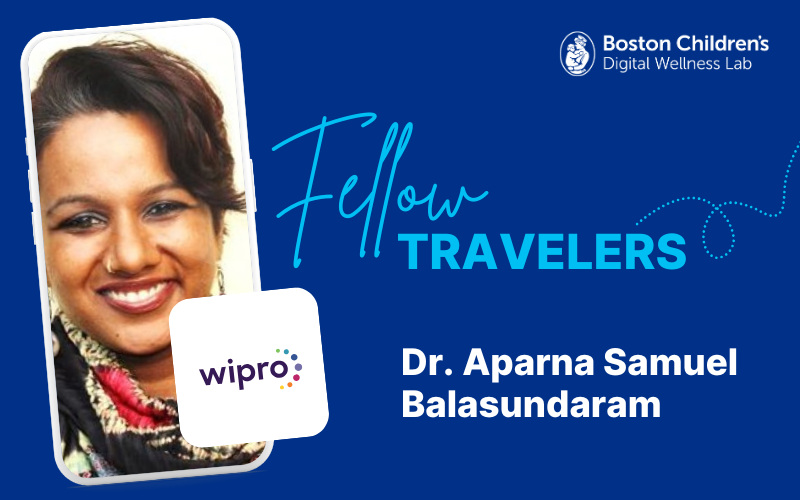
Dr. Aparna Samuel Balasundaram
Global Head of Wellbeing and Resilience, AI & Immersive Operations, BPS, Wipro
What’s your organization’s mission, and what’s your area of focus?
Wipro Limited is a leading AI-powered technology services and consulting company focused on building innovative solutions that address clients’ most complex digital transformation needs. Leveraging our consulting-led approach and the Wipro Intelligence™ unified suite of AI powered platforms, solutions, and transformative offerings, we help clients realize their boldest ambitions and build intelligent, sustainable businesses.
We build resilient systems designed to protect users, especially vulnerable populations like children and teens from harm, while promoting wellbeing and responsible engagement to ensure digital platforms are secure, respectful, and conducive to healthy interactions.
At Wipro, our mission is to earn customer trust and maximize value through innovation, integrity and excellence. This commitment is deeply embedded in our culture and expressed through the Spirit of Wipro which guides us to be passionate about our clients’ success, act globally and responsibly, treat each person with respect and uphold unyielding integrity in everything we do.
These values are further reinforced by our Five Habits namely being respectful, being responsive, always communicating, demonstrating stewardship, and building trust. Together, they shape how we deliver transformative solutions, foster inclusive collaboration and contribute meaningfully to our clients, communities, and the planet.
In the Trust and Safety domain, Wipro focuses on advancing human-centric innovation that ensures digital experiences are not only intelligent but also ethical, inclusive and safe. We build resilient systems designed to protect users, especially vulnerable populations like children and teens from harm, while promoting wellbeing and responsible engagement to ensure digital platforms are secure, respectful, and conducive to healthy interactions. It’s about proactively identifying risks, mitigating harm, and promoting digital wellness across all age groups.
For example:
- In social media and content platforms, we support real-time content review systems that flag misinformation, hate speech, and harmful imagery, while preserving freedom of expression.
- In AI development, we contribute to ethical data mapping and annotation practices that reduce bias and ensure fairness in algorithmic decision-making.
By combining technological innovation with ethical stewardship, Wipro’s Trust and Safety initiatives aim to create digital ecosystems where users feel protected, respected, and empowered.
This work is personal. It’s about protecting the protectors. It’s about designing tech that heals, not harms. And it’s about ensuring that empathy, ethics, and evidence-based research, guide every step we take.
What led you to this work?
My journey into wellbeing and Trust & Safety wasn’t a straight line. It was a calling shaped by lived experience, clinical training, a deep desire to help people realize their potential and humanize workspaces.
Early in my career, as Director of Counselling and Social Services at an inpatient psychiatric hospital, I worked with individuals in crisis, learning firsthand how trauma-informed care can transform lives. Later, I set up a Counselling Center, where we designed and delivered programs that equipped thousands of young people and families with practical tools for resilience, relationship management and self-advocacy.
My journey then took me into the space of Corporate and Organizational Psychology, where we worked with several Fortune 500 companies to create thriving workspaces with a focus on people and performance.
I’ve always been drawn to the intersection of psychology and purpose—it was in the high-pressure world of content moderation, where people face emotionally intense digital content daily that I saw the urgent need for scalable, science-backed wellbeing systems. At Wipro, we’ve built a wellbeing ecosystem that delivers over 350,000 touchpoints annually, grounded in clinical expertise, digital innovation, and cultural sensitivity. From pioneering the RTC-10 psychometric scale to launching AIRA, our AI-powered resilience chatbot, our work is driven by one belief which is, when people thrive, performance follows.
This work is personal. It’s about protecting the protectors. It’s about designing tech that heals, not harms. And it’s about ensuring that empathy, ethics, and evidence-based research, guide every step we take.
Because when we protect the protectors, we create a ripple effect. One that reaches every young person navigating the digital world and when we do that well, we create safer, kinder digital spaces for all young people across the globe.
What have you learned in the course of doing this work about young people’s wellness while engaging with tech and interactive media, and how does working in Trust and Safety from the viewpoint of protection of young people influence your work?
Through my work leading wellbeing for Trust & Safety teams— and earlier working with thousands of youths and their parents across schools and communities and helping them build life skills, emotional and digital literacy—I have learned that digital media can be both a mirror and a magnifier of youth identity, emotion, and vulnerability.
For young people, their digital lives are not separate from their real ones; they are immersive, emotional, and often formative. Teens seek connection, validation, and self-expression online. But without thoughtful design and safeguards, these same spaces can expose them to harm like cyberbullying, misinformation, and emotional overload.
Our youth deserve digital spaces that are safe, inclusive, and empowering. And those who protect these spaces, our Trust & Safety teams, deserve care that is just as intentional. Protecting young people means protecting those who protect them. It’s a lesson I have carried into my work at Wipro, where we have built trauma-informed systems to support the wellbeing of Trust & Safety professionals.
Because when we protect the protectors, we create a ripple effect. One that reaches every young person navigating the digital world and when we do that well, we create safer, kinder digital spaces for all young people across the globe.
What guidance or advice do you have for parents and other caregivers to help kids to build and maintain their wellness when engaging with digital media and technology?
Parents and caregivers often ask, “How much screen time is too much?” But the better question is, “What kind of screen time builds wellness?”
My advice is to shift from monitoring to mentoring. Instead of enforcing rules, co-create digital boundaries. Ask your child what excites them online, what confuses them, and what makes them feel seen. These conversations build trust and emotional safety.
Create a family digital wellness plan-not as a set of restrictions, but as a shared agreement. Include rituals like tech-free dinners, emotional check-ins after screen time, and co-viewing content. Let kids help shape the boundaries-they’re more likely to follow what they co-create.
Model digital self-care. Share your own struggles with tech overload and how you manage it. This normalizes the effort and shows that wellness is a lifelong practice.
And most importantly, as caring adults, validate their digital lives. For many young people, online spaces are where they explore identity, build friendships, and seek affirmation. When we honor that, we help them build emotional wellbeing and a positive sense of self.
If we want technology to support youth wellness, we must design it with their developmental needs and not just their digital behaviors in mind.
How would you change or design technology and/or media to be healthier for kids across the developmental span?
Earlier, in my role as adjunct faculty at Columbia University’s School of Social Work, I designed and taught courses on Human Behavior and Social Environments, where we explored how ecosystems, including digital technology can shape developmental trajectories, across the human lifecycle. Given its critical influence, as both a risk and protective factor, we had a special focus area on digital technology and media and its impact on adolescents. Their online experiences are immersive and emotionally charged, often influencing how they see themselves, relate to others, and form their sense of belonging.
Finally, co-design with youth. They are not just users; they are co-creators. Involving them in design decisions ensures we create digital ecosystems that nurture their growth, voice, and wellbeing.
If we want technology to support youth wellness, we must design it with their developmental needs and not just their digital behaviors in mind.
- For younger users, platforms should prioritize simplicity, safety, and emotional regulation. For teens, tools should support identity exploration, peer connection, and critical thinking. Age-appropriate nudges, content filters, and emotional check-ins can help tailor experiences to developmental stages.
- Digital platforms must be inclusive and reflect diverse identities, reduce algorithmic bias, and be accessible to neurodiverse users. They must offer culturally sensitive content and empower users to feel seen, safe, and supported
- Finally, co-design with youth. They are not just users; they are co-creators. Involving them in design decisions ensures we create digital ecosystems that nurture their growth, voice, and wellbeing.
Is there anything else you’d like to share?
Beyond our business commitments, Wipro is deeply invested in social impact through philanthropy and community development. The Azim Premji Foundation, established by Wipro’s founder, is one of the largest philanthropic initiatives in India, dedicated to improving education and equity at scale. The Foundation has committed billions of dollars toward building a just, humane, and sustainable society demonstrating that trust and responsibility extend far beyond corporate boundaries.
This ethos directly aligns with our work in Trust and Safety, where we strive to create digital environments that are ethical, inclusive, and protective of vulnerable populations. Just as the Foundation works to uplift communities through education and empowerment, our Trust and Safety teams build systems that foster wellbeing, resilience, and responsible engagement in the digital world. Together, these efforts reflect Wipro’s belief that technology and compassion must go hand in hand to create lasting change.
We know that no one person, organization, or company can successfully address the challenge alone, so it’s imperative that we collaborate to design and maintain a healthier digital experience for all young people and their families. Our Fellow Travelers blog series features colleagues from around the world who focus on digital wellness from a different perspective than the Digital Wellness Lab, enabling us to share expertise in key areas of digital wellness that we don’t explore as deeply.
Here at the Lab, we welcome different viewpoints and perspectives. However, the opinions and ideas expressed here do not necessarily represent the views, research, or recommendations of the Digital Wellness Lab, Boston Children’s Hospital, or affiliates.