





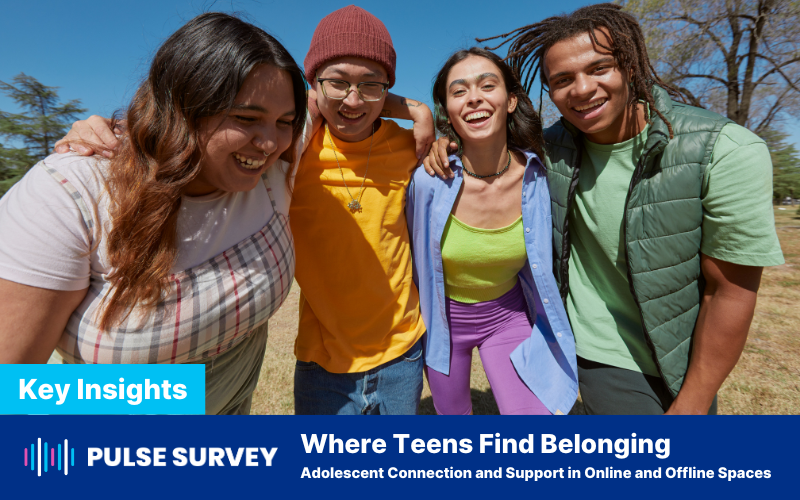
When we talk about teens and technology, the conversation often becomes binary: Are digital spaces helping or hurting young people’s ability to connect? Are online friendships “real”? Should we be worried about screen time replacing face-to-face interaction?
Our latest Pulse Survey suggests these either/or questions miss what’s actually happening in teens’ lives. We surveyed nearly 1,600 adolescents across the U.S. to understand where they find belonging, how they experience connection across online and offline spaces, and what role technology plays in their social support systems.
What we found challenges some common assumptions about teen connection and reveals a more nuanced picture of how today’s adolescents navigate belonging.
The Complexity of Connection
Teens are learning to navigate multiple social worlds, trying on different identities, and figuring out where they fit. So while a majority of teens feel connected to others and experience belonging, many still report feelings of exclusion.
72%
of teens feel they “have a place at the table with others”
70%
say they “have a sense of belonging”
Over 50%
of teens report feeling like an “outsider” (56%) or a “stranger” (52%) when around other people
Friends and Family Form the Foundation
Despite headlines suggesting technology has replaced in-person connection, traditional sources of support remain central to teens’ lives.
3 in 4
teens feel socially supported by friends and family
75%
feel “safe” and “comfortable” at home
73%
have friends they trust completely
When it Comes to Belonging, Not All Platforms Are Created Equal
We found significant differences in how teens experience belonging across online spaces:
Highest Sense of Online Belonging =
Messaging and video chat apps and social media platforms
Lowest Sense of Online Belonging =
Video-sharing sites
We also found notable gender differences in platform experiences. Boys report higher belonging across nearly all platforms, with the gap most pronounced in gaming spaces. Plus, 57% of boys report having close online friends who they’ve never met in-person, compared to 43% of girls.
Online Friendships Are Real Friendships
Teens are blending online and offline contexts in ways that challenge the “digital vs. real world” framing.
1 in 2
teens have “friends” who they know from online spaces, but have never met in person.
67%
of those teens say these online-only friendships are equally important as their in-person friendships.
36%
of teens who make friends on social media have met those friends in person
Online and Offline Belonging Aren’t Competing Forces
Our research reveals specific patterns of how teens’ offline support systems potentially relate to their experience of belonging online. Consistently, teens with the least amount of support from their friends, family, or school also felt less belonging in online spaces. However, the more support participants had from their friends or school environment, the stronger their sense of online belonging. In addition, teens with a moderate amount of support from their family, or feelings of general belonging reported the highest online belonging–suggesting they’re most actively building connections across contexts.
These findings contradict the idea that teens turn to online spaces to compensate for lacking offline connection. Instead, online spaces seem to extend and enhance existing support systems, or highlight gaps that already exist in someone’s network.
The takeaway for parents, educators, and anyone who works with young people? Online and offline belonging are interconnected parts of how teens build social support systems.
Rather than asking whether technology helps or hurts connection, we should ask:
- How can we help teens build healthy relationships both online and offline?
- What role can families and schools play in teaching teens to navigate digital spaces safely?
- How can platform designers create environments that genuinely support belonging and the adolescent need for connection?
The teens in our study are navigating two worlds, building friendship and community in offline and online spaces. Our job is to support them in both, not ask them to choose.
Read the Full Report →This Pulse Survey was conducted by the Digital Wellness Lab at Boston Children’s Hospital in July-August 2025. We surveyed 1,598 U.S. teens aged 13-17 using validated scales to measure belonging, social support, and online connection. Full methodology is available in the report.