


Conversations about young people and technology often come down to two questions: how much time they spend online, and whether online life is replacing meaningful connection. However, those questions leave a lot out about how teens and young adults spend their time. Young people’s social lives do not divide neatly into online and offline, and how they connect matters as much as where they connect.
To look deeper, the Digital Wellness Lab at Boston Children’s Hospital and Gallup, with support from the Pinterest Impact Fund, are conducting a two-phase, cross-national study. In Phase 1, we surveyed nearly 16,000 young people ages 15 to 22 in 16 countries about their relationships, what they do online, how they perceive their online life, and their general wellbeing and mental health. Initial results are published in our new report, Friendship in an Online-Offline World: Digital Life, Connection and Wellbeing Among Young People. In Phase 2, we are conducting focus groups with young people in four of the 16 countries to explore these findings in more depth, with results expected in early 2027.
To better understand the breadth of connection in young people’s lives, we asked questions about three modes of friendship:
In-person
Friendships maintained primarily in person
Offline-to-online
Friendships that began in person but now live mostly online
Online-only
Close friendships with people known only online
Digital life is about more than screen time
Understanding young people’s digital lives requires looking beyond how much time they spend online, to what they do there and with whom. Scrolling short-form videos is the most common activity. Most young people have used AI to look for information, and about a third have used it as a social companion or friend. Much of their online communication is with people they already know in person, such as friends and family. There is also a relationship between use and quality: the more frequently a young person texts, calls, or sends content like videos to an online friend, the higher the quality of that connection.
Share of young people who often or very often:
72%
scroll short-form content
59%
actively engage with others
56%
learn or find new information
Young people connect in many ways
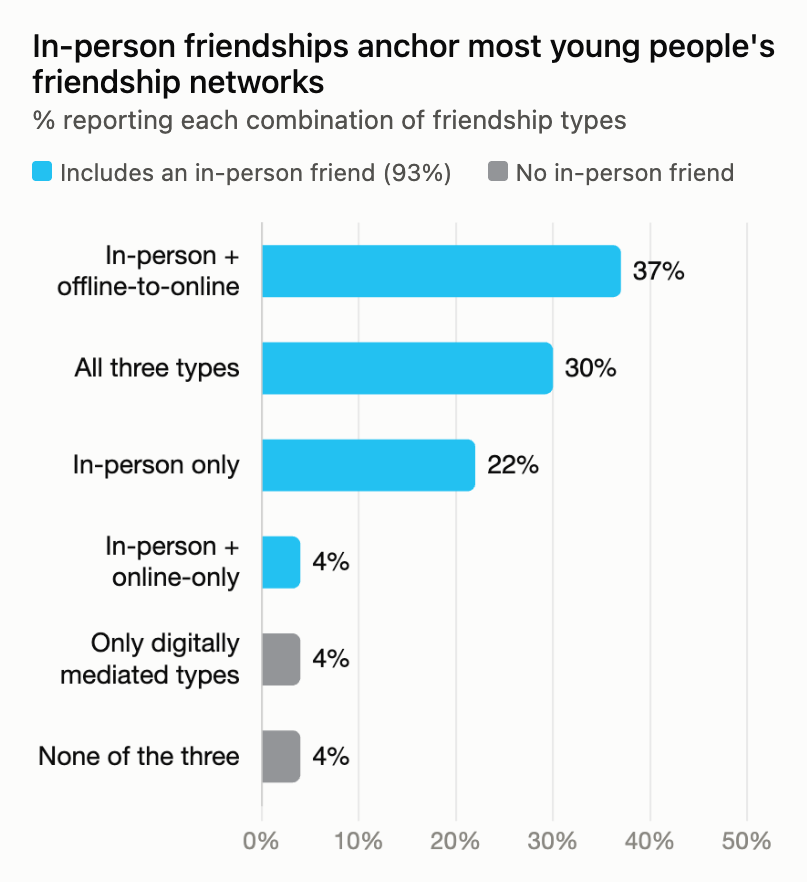
For most young people, connection is not confined to online or offline settings. Nearly all young people have close friends they see in person, and most also keep up friendships online, either with people they originally met in-person, or who they know from entirely online settings. In-person relationships anchor these networks: very few young people have online friendships without also having an in-person friend. Relationships with adults matter too: young people without a trusted adult outside the family, such as a teacher, coach, or mentor, are more likely to report having no close friends.
Online and offline social lives coexist
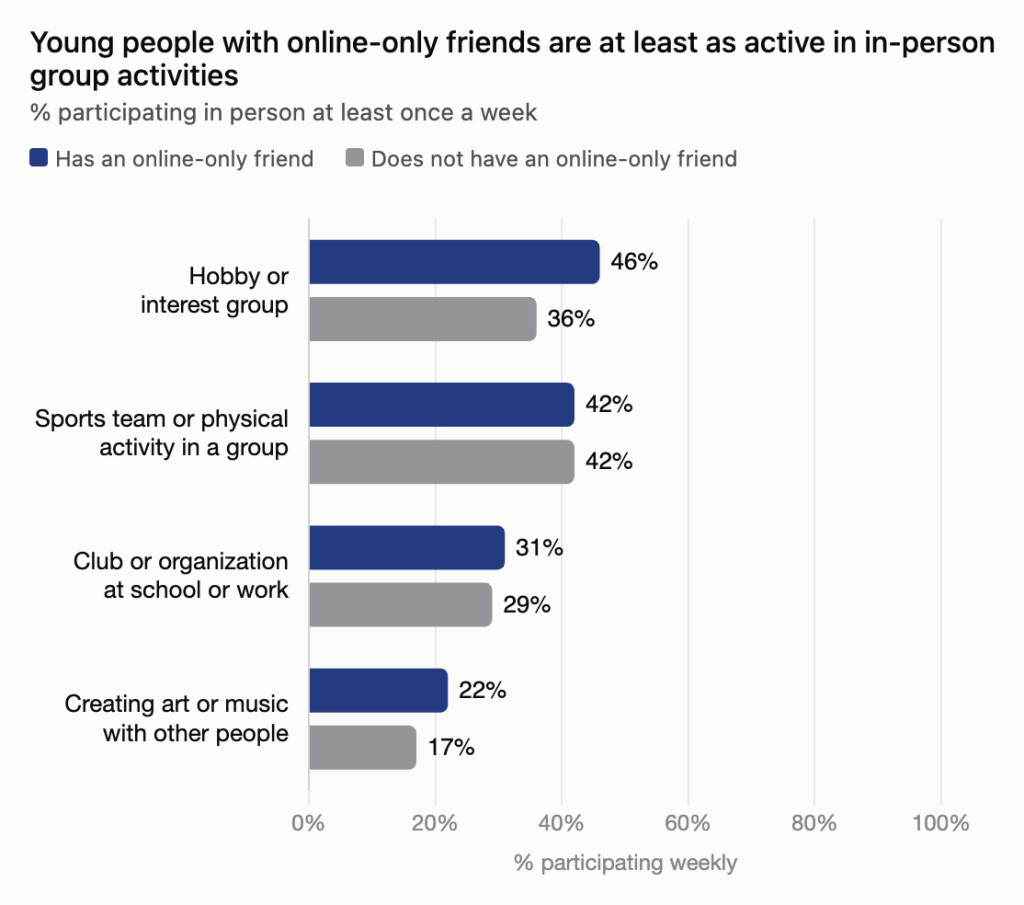
A common concern is that time spent connecting online comes at the expense of in-person connection. Our findings suggest that digitally-mediated friendships may add to, rather than replace, in-person relationships. Young people with online-only friends participate more often than their peers in every in-person group activity measured except for group physical activity, from interest groups to school clubs. Even so, young people with online-only friendships are less likely to be satisfied with the time they currently spend with friends in person.
There are differences in how young people build and experience online social life
Male and female youth differ in where they form online-only friendships. Young men tend to make close, online friends through gaming platforms, and young women are making close, online friends through social media platforms.
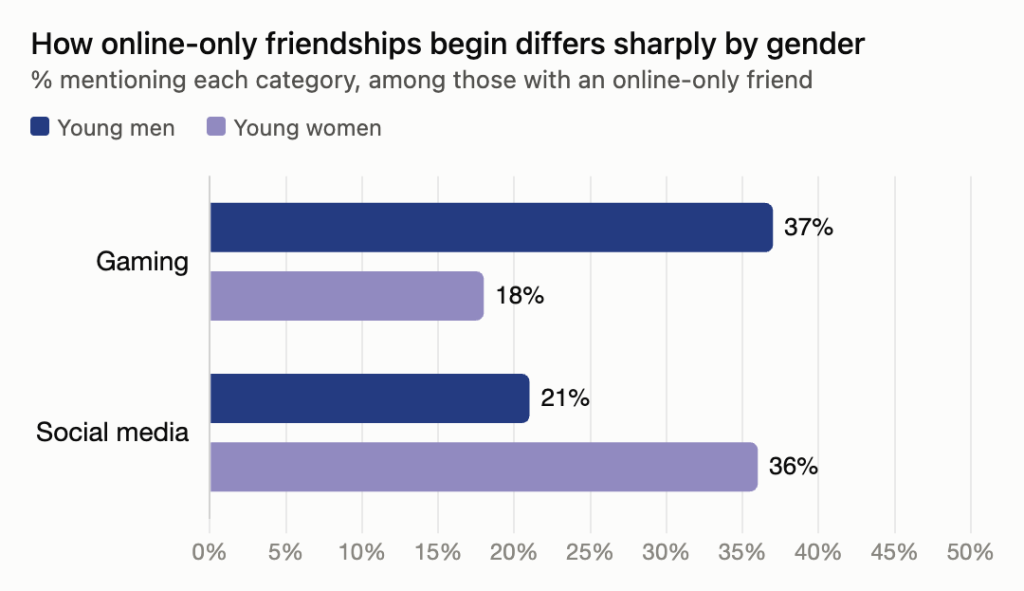
For ease of multinational reporting, we recruited participants who identify as male or female. Follow-up work with gender minority youth is an important and ongoing priority.
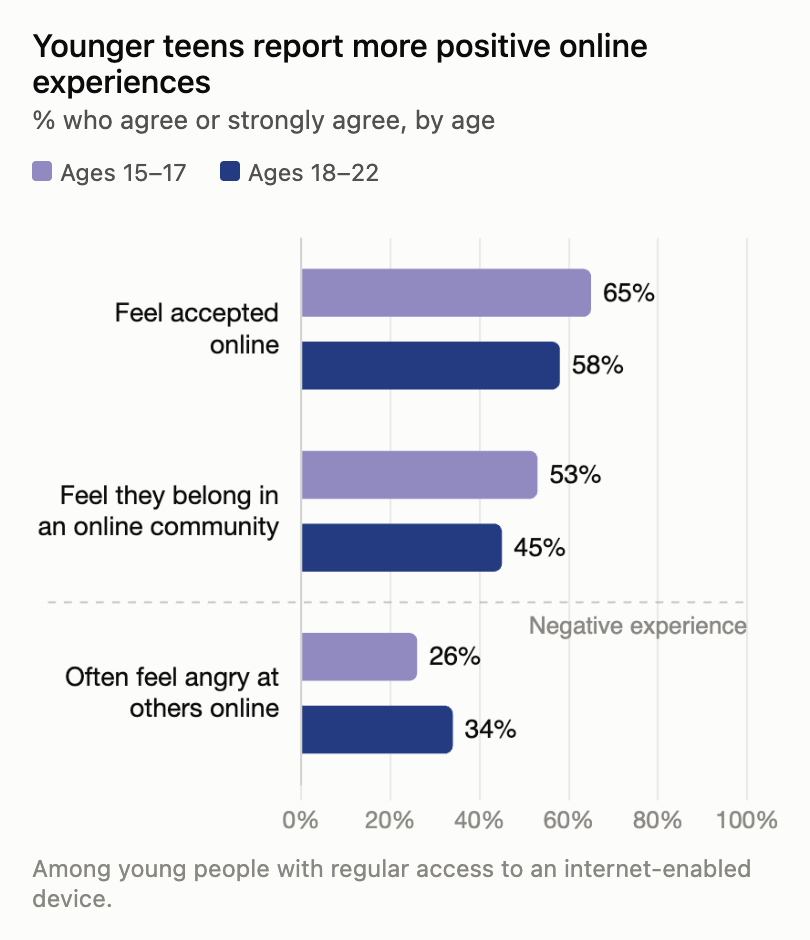
Not all young people experience online belonging and support in the same way. Most young people report positive experiences of belonging and support in their online lives, but key differences emerge within age groups: young adults report less positive and more negative social experiences online.
The quality of the connection matters
Having a close friend is only part of the picture. Young people rated the strength and supportiveness of their closest friendship in each mode, and in-person friendships received the highest ratings. Strong friendships also tend to go together: young people with a stronger in-person friendship generally report stronger online friendships as well.
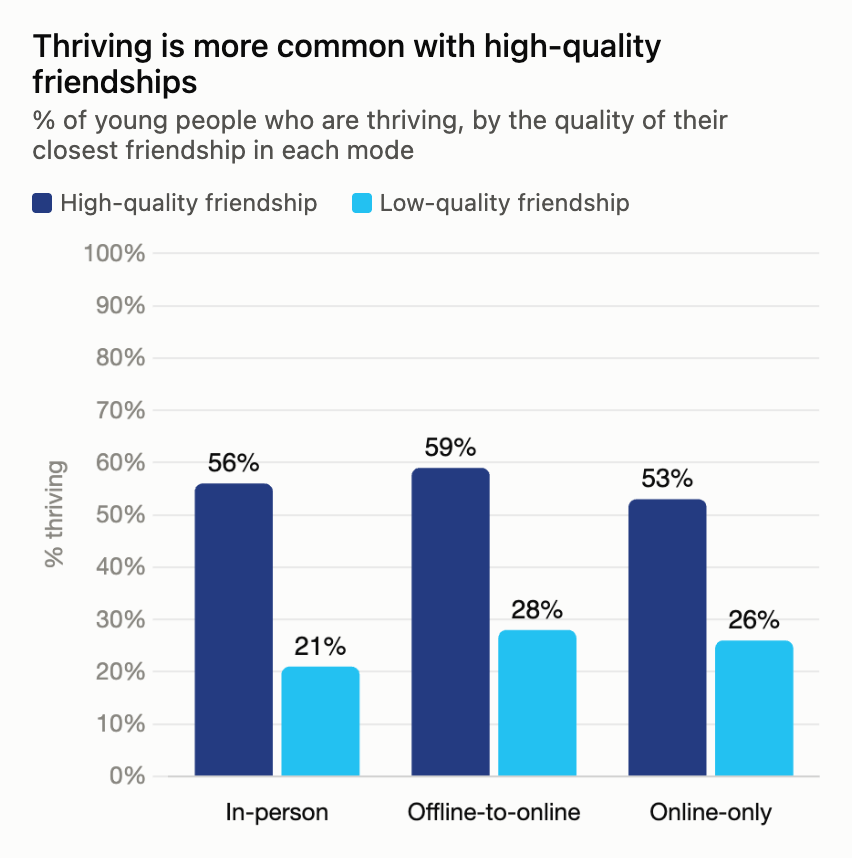
When it comes to loneliness, higher-quality in-person friendships are associated with lower loneliness, thought the same cannot be said for digitally-mediated friendships. The link with thriving is broader. Across all three friendship modes, the share of young people who are thriving—meaning they rate both their current and expected future lives highly—rises with friendship quality.
Supportive relationships go beyond friendship
Adults, in addition to in-person friends, remain central to young people’s lives. The quality of young people’s relationships with parents or caregivers shows an especially strong association with thriving, even after accounting for friendships and other factors.
Young people with a high-quality in-person friendship have about twice the odds (2.0) of thriving as those without one.
Young people with a high-quality caregiver relationship have almost three times the odds (2.7) of thriving as those without one.
Young people without a trusted adult outside the family have about almost seven times the odds (6.8) of having no close friends.
Odds are adjusted for country, age, gender, and other factors.
What this means for young people
These key takeaways illustrate the ways in which young people’s social lives span settings, fitting together in ways that require us to think deeply about the design and interpersonal elements that can support their positive development. Most young people maintain close connections online, and we are learning that it’s not just about platform design, but about the quality of the connection that can be maintained there. And yet, the strength of in-person support from friends, caregivers, and trusted adults remains the foundation– they play an essential role in young people’s lives as the settings for their connections grow to include online spaces.
These findings raise questions for everyone who has a role in shaping young people’s digital lives:
Families, schools & communities
How can we help to strengthen the in-person systems of support that young people rely on?
Platform designers
How can design support the trust, rapport, and shared interests that characterize strong online connections?
Policymakers
How can policy look towards building the conditions that help young people build supportive relationships, online and off?
What’s next
Phase 2 findings are expected in early 2027. To receive updates on this research and more, sign up for our newsletter at digitalwellnesslab.org/newsletter.
Read the Full Report →About the research. This two-phase study is being conducted by the Digital Wellness Lab at Boston Children’s Hospital and Gallup, with support from the Pinterest Impact Fund. In Phase 1, between May and August 2026, young people ages 15 to 22 were surveyed online in 14 countries (Argentina, Australia, Belgium, Brazil, Canada, France, Germany, Italy, Japan, the Netherlands, Poland, Spain, the United Kingdom, and the United States) and face to face in Kenya and South Africa. Because the study is observational, its findings describe associations rather than causal effects.
How we are funded. The Digital Wellness Lab’s work is made possible by individuals, foundations, and corporate supporters, including technology, entertainment, and healthcare companies. We do not conduct research for hire or accept funding that could compromise our autonomy or objectivity, and we do not evaluate, endorse, or give preference to specific products or platforms. Pinterest had no role in this study’s design, analysis, or findings. Learn more on our Supporters page.