



A 4-year-old asks her talking toy if it loves her. What should it say?
AI is already a part of life for many young children, through conversational toys, AI-powered apps, and smart speakers. According to a recent report, 37% of children in the US ages 0–8 interact with an AI toy and 56% with voice assistants at least occasionally, with 12% using AI toys every day (Robb & Mann, 2026). New products are arriving faster than ever, and the teams behind them are making choices about how the AI talks with a child, what it lets a child believe about it, when it nudges the child toward a caregiver, and what happens to the child’s data. Each of those choices shapes a young child’s experience, yet the research that could guide those teams isn’t always easy to find.
“Teams building AI toys and other AI-enabled products for young children are facing a lot of new questions, but much of the knowledge needed to answer them isn’t new,” said Brinleigh Murphy-Reuter, DigitallyWell project lead. “Decades of child development research can help inform those design choices. The key is getting it to the people making them in a format that makes it easy to apply best practices and create healthier experiences for young kids.”
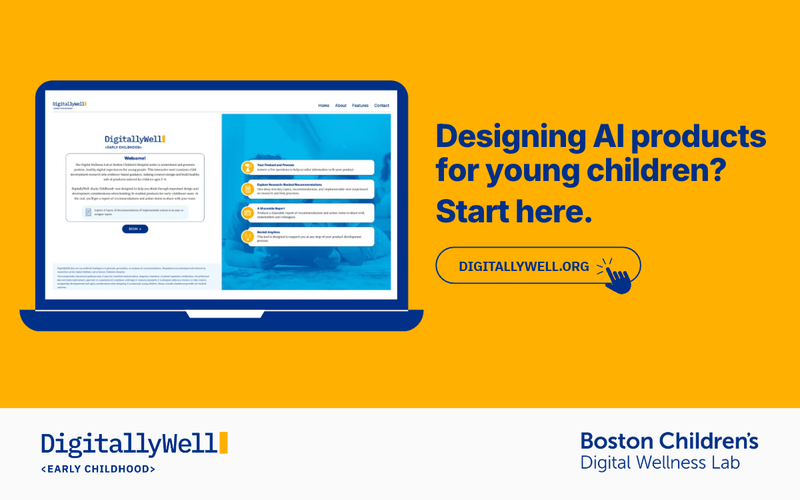
To help product teams design healthier, safer AI experiences for children, the Digital Wellness Lab at Boston Children’s Hospital is excited to announce the launch of DigitallyWell, a free web-based tool that puts child development research at teams’ fingertips as they make design decisions.
Why we built DigitallyWell
Rigorous research on how children learn, form relationships, and make sense of technology exists, but it can be difficult and time-intensive for product designers and safety teams to locate, interpret, and apply these findings. The Lab developed DigitallyWell to close that gap, giving the people building these products the research they need to design better experiences for kids today, while the field continues to build the evidence that will guide child-AI interaction in the future.
Research on how young children and families interact with AI-embedded products, and the impacts of that engagement, is emerging, but the fundamentals of child development haven’t changed. The Lab’s 2025 analysis found that most existing guidance on AI for kids focuses on privacy and safety, while staying nearly silent on developmentally important issues such as relationship formation and attachment. DigitallyWell is designed to rebalance the guidance, addressing four areas equally: understanding AI, human connection, healthy development, and safety, privacy, and transparency.
How it works
Get free, research-based design guidance for AI-enabled products used by young children It takes three steps and less than 30 minutes:
1. Input basic information
Share your role, the type of product you’re building, and your product development stage. You won’t be asked for proprietary details, and no identifiable information is collected.
2. Review your recommendations
The tool provides evidence-backed recommendations based on your answers.
3. Get your report
Download a shareable report of recommendations and action items for planning, design reviews, and conversations with stakeholders.
DigitallyWell covers a range of product types, including physical toys and robots, tablet and phone apps, smart speakers, and other screen-based and screen-free devices, at every stage of product development, from initial concept to post-launch updates. As their product changes, teams can come back for new guidance.
“When we build a new product, youth well-being is a priority from day one, and we want every decision to reflect the best available evidence,” says Arjun Venkataswamy, Principal Product Manager at Alexa Kids. “DigitallyWell puts research-backed recommendations and solutions at my fingertips. In about 30 minutes, I can gain clear, actionable insight on critical product decisions that could have taken weeks to understand in the past.”
What the guidance looks like in practice
DigitallyWell’s recommendations span four themes, all designed for young children. Some examples:
Understanding AI
Help young children learn, in simple and age-appropriate ways, what the AI is, what it can and can’t do, and what role it plays in their lives.
- Include a large “Get a grown-up” button, so a child can bring in a caregiver at any point.
- Have the AI say when it doesn’t know the answer, rather than guessing.
Human Connection
Set clear limits on the AI’s role in a child’s life, and design it to strengthen bonds with caregivers and other children.
- Never suggest the AI has feelings or emotional capacities.
- Offer activities that the child can only complete offline.
Healthy Development
Design features that support children’s thinking, language, play, and emotional growth.
- Have the AI pause after it asks a question, giving the child time to think and respond.
- Make sure activities can be repeated. Young children learn through repetition.
Safety, Privacy, and Transparency
Build and deploy AI products that protect children, safeguard their data, and are open about how they work.
- Leave out features designed to maximize engagement.
- Keep interaction data from being used for profit or profiling.
Each recommendation comes with clear implementation steps that teams can act on.
“DigitallyWell streamlines the [product development] process and takes out the guesswork. Within 30 minutes, I can make critical, research-backed product decisions that would have taken over a week to validate in the past.”
Grounded in research, written by humans
DigitallyWell starts with global policy guidance, uses developmental science to turn it into concrete steps, and integrates the recommendations of experts in child development and safety.
- Global guidance. We reviewed more than 30 policy and advocacy documents published between 2020 and 2025, including guidance published by UNICEF, UNESCO, the OECD, the World Economic Forum, the Council of Europe, the U.S. Department of Education, 5Rights, and CARU, along with the Lab’s own Recommendations for Industry: Use of Voice Assistants and Generative AI by Children and Families. These sources contained more than 200 discrete recommendations, which became the starting point for DigitallyWell’s guidance.
- Developmental science. We combined the recommendations with relevant research on how young children learn, how they treat technology or other media as a social partner, how they think about what AI is, and the valuable role of human interaction in early childhood.
- Expert validation. In 2025, we gathered a small group of child development experts, product designers, and youth representatives at a workshop held at the Radcliffe Institute for Advanced Study at Harvard University to review and validate the list of recommendations. This group narrowed the list to the guidance that matters most for young children.
- Shaped by practitioners. We collected input from industry practitioners through a needs assessment to inform how the tool is designed and built to fit the way product teams work.
DigitallyWell is not an AI-enabled tool. Researchers at the Lab wrote and reviewed every recommendation and corresponding action item. The tool supports design decisions and is meant to sit alongside user testing with young children and their caregivers.
Try DigitallyWell with your team today
If you’re building AI products for young children, DigitallyWell offers free, evidence-based guidance for safer, healthier products at every stage of product development. Try it, and pass it along to colleagues building tools and toys for young kids.
OPEN TOOLYour feedback will help shape future updates to DigitallyWell. Please email us and let us know how it’s working for your team.
DigitallyWell was developed by the Digital Wellness Lab at Boston Children’s Hospital, with technical development by FableVision Studios and financial support provided by the Esther A. & Joseph Klingenstein Fund. The tool offers guidance only and does not certify, rate, or endorse products.
Special thanks to the Lab project team who conducted the research and developed the tool’s content and design: David Bickham, Alice Huang, Zoë Kronberg, Kat Mitchell, Brinleigh Murphy-Reuter, Wren Opperman, and Alicia Owens.