

Authored by Vihaan B.
Member, Digital Wellness Lab 2025-26 Student Advisory Council
If we truly care about student mental health, the urgency we bring to restricting digital spaces must be proportional to the commitment we make to improving physical ones.
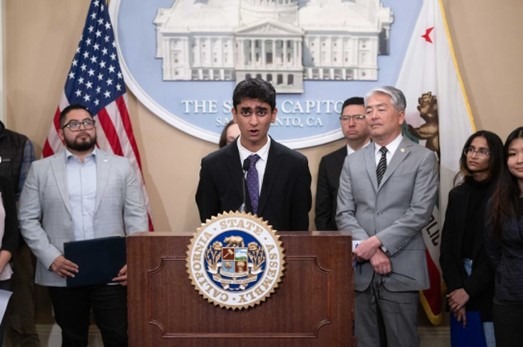
The momentum is undeniable. Texas, New York, Virginia, Florida, Alabama, Louisiana, Ohio, Arkansas, Oklahoma, Kansas, and Georgia have all enacted full bell-to-bell (a.k.a full day) phone bans in recent months. As a student advocate, I’ve been at the frontlines of championing California’s AB 1644 — the bipartisan bill authored by Assembly members Josh Hoover, Al Muratsuchi, Josh Lowenthal, and Buffy Wicks that would require all TK-12 public schools to prohibit smartphones from first bell to final bell. I believe in this bill and have helped make the case for it.
But I’ve also started asking a harder question: what exactly are we banning students into?
A phone ban is only half a policy. The other half is what happens in the physical space that students are expected to immerse back into — and that half, in most states, has gone almost entirely unaddressed.
The Assumption Embedded in the Bans
Most phone bans have rested on the premise that without their devices, students will re-engage with the physical world around them. The current research justifying these bans leans heavily on this premise. The amazing benefits it points to include reduced distraction, improved focus, better interpersonal connection.
But the premise only holds if the physical world is worth re-engaging with.
For many students, it isn’t. Not because they’re spoiled or addicted to their devices, but because the school environment they inhabit has failed them. To those who are bullied, socially excluded, neurodivergent, LGBTQ+, or simply invisible in the curriculum and culture of their school, their phones often served as lifelines to community, identity, and safety that their schools did not make any effort to provide.
It would be ignorant to celebrate banning phones without addressing, or at the very least reflecting upon, the realities that have led phones to hold such a vital position in our lives.
Beyond the Bans
This is not an argument against bell-to-bell bans. Instead, I contend that rather than applying the current political momentum solely to banning phones, we have the potential—and more importantly, the need—to accompany such laws with a series of other reforms that ensure we are holistically solving the youth mental health crisis.
For those reasons, I suggest:
- Clear, transparent communication from schools about why phone policies exist, what they do and don’t cover, and what logistics, consequences, exceptions, and appeals students and families can expect. The Digital Wellness Lab in their May 2025 Pulse Survey found that when students understand the purpose behind phone-related rules, compliance follows much more easily.
- Genuine investment in inclusive school climates. If LGBTQ+ students are being removed from their online communities, schools must affirmatively offer them something — GSAs, inclusive curricula, trained counselors, visible adult allies. The states leading the charge on phone bans — Texas, Florida, Louisiana — are in many cases the same states whose legislatures have passed laws restricting LGBTQ+ content and materials in classrooms. Policymakers cannot have it both ways. You cannot simultaneously eliminate the digital spaces where marginalized students find community and refuse to build physical ones that are conducive to their identity.
- Support for neurodivergent students built into the implementation of every ban — not retrofitted as an afterthought, but codified as part of what a “bell-to-bell ban” means. The definition of these bans must account for students with IEPs and 504s who rely on assistive technology, and schools need staff trained to implement exceptions without stigma.
- Student voice in the design of policy. The Digital Wellness Lab is unambiguous: when students participate in shaping the rules that affect their lives, those rules are more likely to be seen as fair, and more likely to be followed. Student advocacy shouldn’t end at the press conference announcing a ban. It should begin there.
The urgency we bring to restricting digital spaces must be proportional to the commitment we make to improving physical ones. These policies send a message to students: we care about your wellbeing enough to act. But that message rings hollow if the physical environment of the school they’re being redirected to is one where they are bullied, erased from the curriculum, under-resourced, or made to feel like they don’t belong.
We cannot police digital spaces while neglecting the real-world exclusion that drives students there.
I support AB 1644 and similar legislation. I will keep advocating for it. But I am also asking my fellow advocates, and the policymakers and administrators who have sought bell-to-bell bans to consider this message: let’s not stop at the phone. Let’s use this momentum to go a step further, and fundamentally rethink the environments of our schools.
Vihaan B. is a member of the Digital Wellness Lab’s 2025-2026 Student Advisory Council, and is currently a high school junior in San Diego, CA.
The author of this article is a young person who has been engaging with the Digital Wellness Lab about topics of young people’s safety and wellbeing within digital environments. Here at the Lab, we welcome different viewpoints and perspectives. However, the opinions and ideas expressed here do not necessarily represent the views, research, or recommendations of the Digital Wellness Lab, Boston Children’s Hospital, or affiliates.