





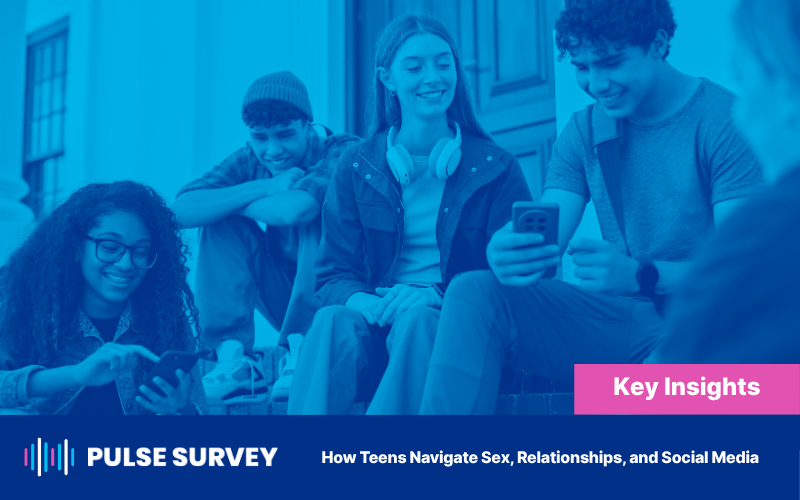
In our latest Pulse Survey, we asked 1,124 US teens ages 16 to 18 about the social norms they hold around sex and relationships, their sexual health literacy and access to education, and the relationship and sexual content they encounter on social media. Roughly one-third of the teens we surveyed (31%) reported being sexually active, which is in line with national data from the CDC.
Our topline takeaways:
Teens View Their Broader Peers Differently Than Their Close Friends
We asked teens to estimate how many “teens their age” and how many of their “close friends” had done certain things. Across every behavior we asked about, teens estimated higher numbers for their broader peer group than for those they considered their close friends.
39%
of teens believed most peers their age had ever had sex, compared to 19% who said the same about their close friends.1
25%
believed most peers their age had had casual sex, compared to 11% who said the same about their close friends.
24%
believed most peers their age had not used a condom the last time they had sex, compared to 14% who said the same about their close friends.
The same pattern showed up in what teens believed their peers approved of. About 61% said their close friends would disapprove of having multiple sexual partners at the same time, compared to 42% who said teens their age would disapprove of the same behavior.
It’s imperative for those designing sex ed curricula and programming to recognize that perceived social norms can impact behaviors even when they’re inaccurate or not representative (Cislaghi & Shakya, 2018). To strengthen sexual health and encourage the development of healthier relationships, educators can leverage teens’ close friends as a protective influence and potentially implement lessons that address misconceptions to minimize unnecessary social pressures to conform to teens’ inaccurate perceptions around sex. Schools and youth-serving programs may also consider peer-led approaches that engage trusted or socially influential students within local networks to model healthier norms and help disseminate accurate information.
Most Teens Support Safe Sex, but Access to Sexual Health Information Are Uneven
Over a third of teens reported never having talked about sexual health or protection with a parent or guardian (39%), and a similar share said the same about their healthcare provider (43%).
73%
agreed that using a condom during vaginal or anal sex helps reduce the risk of STIs.
66%
agreed that using condoms shows care for a partner’s health.
65%
said they had received some form of formal sex education through school or a community program.
Among the quarter of teens who reported never receiving any form of formal sex education, more than half said they also had not gotten this information from their parents or guardians (56%), and nearly two-thirds (65%) said the same about their healthcare provider. Teens without formal sex education also reported less favorable views of safe sex: 63% agreed condoms help reduce STI risk, compared to 81% of teens who had received formal sex education.
When young people cannot get this information from the adults around them, they may turn to other sources, including social media, where accuracy varies widely and may even normalize more permissive or risky behaviors (Altintas & Gul, 2022; McCrimmon et al., 2025; PettyJohn et al., 2025).
Boys Report Less Sexual Health Conversations with Parents, Educators and Healthcare Providers
Boys were less likely than girls to say that they’ve had sexual health conversations in every setting we examined.
45%
of boys reported never discussing sexual health with a parent or guardian, compared to 34% of girls.
50%
of boys reported never discussing sexual health with a healthcare provider, compared to 38% of girls.
30%
of boys reported never receiving formal sex education, compared to 23% of girls.
Boys also expressed less favorable attitudes toward safe sex practices. 68%agreed that condoms help reduce STI risk, compared to 77% of girls, and 60% agreed that using a condom shows care for a partner’s health, compared to 70% of girls.
Together, these findings suggest that boys may be receiving less sexual health information through both formal and informal channels, and/or may also be less receptive to safe sex messaging. Either way, they point to a need for outreach and programming that speaks directly to adolescent boys.
Algorithms Largely Shape What Shows Up in Teens’ Feeds
Teens reported that their overall exposure to relationship and sexual content was moderate to low. Even the most frequently encountered category, ongoing relationship dynamics and breakups, was something teens reported seeing only some of the time. But when teens did encounter content about relationships and sex, algorithm-generated recommendations played a larger role in their exposure than the accounts they personally followed.
42%
said that sexual content in their feeds came mostly from algorithmic recommendations, rather than from creators they follow.2
41%
said the same about content involving ongoing relationship dynamics and breakups.
37%
said the same about animated, edited, or promotional sexual content.
This pattern held across the content category we measured. This finding suggests that much of what teens encounter online related to relationships and sex is being pushed to them rather than sought out, indicating their feeds are not solely a reflection of what they have chosen to follow.
Girls and boys also reported seeing different content. Girls reported higher exposure to content about ongoing relationship dynamics, including healthy relationship skills, standards and expectations, cheating, and breakups. Boys reported higher exposure to animated, edited, or promotional sexual content. These differences may reflect and reinforce broader gendered expectations about how young people relate to sex and relationships.
We also found that teens who had received formal sex education reported lower exposure to more explicit content across most categories. This pattern may suggest an association between the absence of formal sex education and greater exposure to content featuring permissive sexual attitudes and explicit visuals. However, it may also reflect other underlying factors such as differences in school context, media access, or family and peer environments.
Daily Users Engage With AI In Notably Different Ways
The starkest differences in the study showed up between daily users and less frequent users. This pattern held across all three countries.
About half of daily US users—twice as many as less frequent users—said they thought of their chatbot as a real person (46%), had developed a close relationship with it (49%), or had real emotional conversations with it (51%). Among less frequent US users, those figures were less than half as high. Similar gaps appeared in Brazil and, to a smaller degree, in France.
Daily users were also far more likely to say chatting with AI is easier than talking to a real person, that it helps them feel less lonely, and that they feel the need to consult a chatbot before making decisions.
These patterns raise important questions about both the potential benefits and the risks of AI use, and point to the need for further research on what constitutes safe and healthy engagement for the heaviest adolescent users.
What This Means for the Adults in Teens’ Lives
Teens are making sense of sex and relationships across several environments at once: what they think their peers and close friends are doing, what they learn in a classroom, their conversations with trusted adults, and what comes up in their social media feeds. Supporting young people requires a coordinated effort across schools, healthcare systems, families, and the online platforms where teens spend their time.
A few questions to ask ourselves:
How can we help young people see the difference between what they assume their peers are doing and what is actually happening?
Who is having these conversations with the teens in our lives, and who is being missed, particularly among boys?
How do we help teens evaluate the relationship and sexual content that reaches them even when they are not looking for it?
Read the Full Report →1 We asked teens to think about the percentage of “teens their age” and their “close friends” who have engaged in these behaviors. The answer options range from 0%, 10%, 20%…90%+; thus, when we reference “most peers” in this section, we’re referring to teens who believed 60%+ of peers and/or close friends who have had these experiences before.
2 When we say “mostly,” this refers to teens who reported seeing these types of content from algorithmic recommendations “mostly” or “almost always”
This Pulse Survey was conducted by the Digital Wellness Lab at Boston Children’s Hospital with support from the Aerosmith Endowment Fund, surveying 1,124 US teens ages 16 to 18 between January and February 2026. Full methodology is available in the report.